עלייה לרגל
Going up to Jerusalem
1. Home
Leaving home
Three times a year the Torah calls the people to appear in the chosen place, and not to come empty-handed.
2. The road
On the road
First-fruit pilgrims gathered in the main town of their district and slept in the open square. At dawn the officer called out ‘Let us arise and go up to Zion’, and a flute played before them.
The Psalms of Ascents (120 to 134) are often linked to pilgrims on the road; the Mishnah links them to the fifteen steps in the Temple. How they were sung on the way is not known.
Open question: The sources disagree or are silent. The site does not choose an answer.
3. Jerusalem
Welcomed into the city
Near Jerusalem the officials went out to meet them, and the city's craftsmen stood up from their work to greet the pilgrims by the name of their town.
4. The climb
The ascent
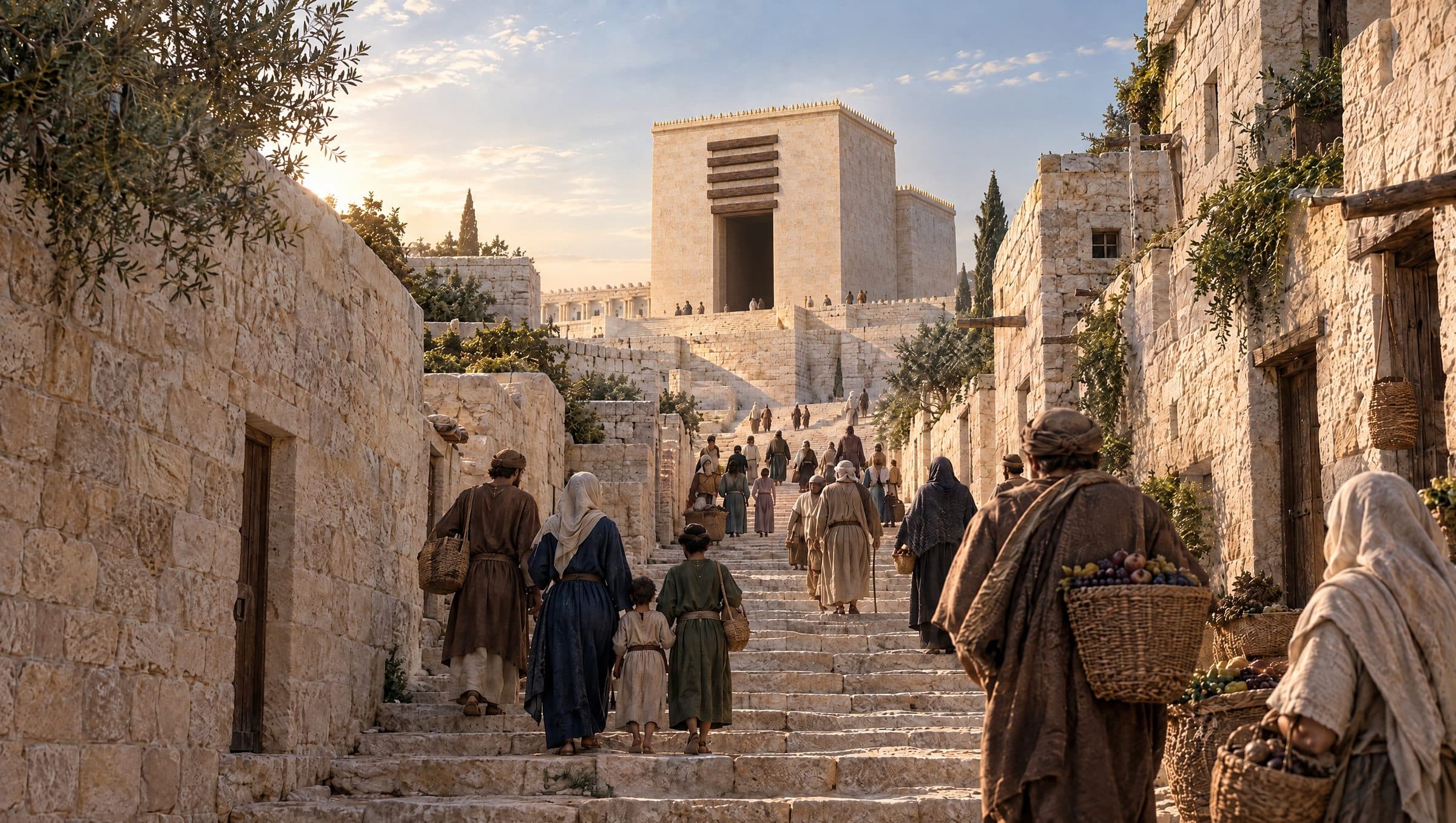
In Hebrew, pilgrimage is aliyah, going up. From the Jordan valley the road climbs about a thousand metres. And as you climb, the House comes into view.
A Song of Ascents; of David. I rejoiced when they said unto me: 'Let us go unto the house of the LORD.' Our feet are standing within thy gates, O Jerusalem;
The Holy Scriptures: A New Translation 5. Before entering
Purification
No one entered the Temple court, however clean, without first immersing. Those impure from contact with the dead needed seven days and sprinkling before they could go in.
6. The Temple
Entering the Mount
Everyone entered by the right, circled and left by the left. A mourner walked the other way, and those who met him said: ‘May He who dwells in this house comfort you.’
7. The courts
Offering and prayer
Pilgrims brought festival offerings, first fruits in their season, and their prayers, facing the Sanctuary. The courts were full, yet the Mishnah remembers that people stood pressed together and still had room to bow.
8. Jerusalem
The festival
‘Thou shalt rejoice before the LORD thy God’: with family, servants, the Levite, the stranger, the orphan and the widow. The festival was a shared meal and a shared city.
9. Home again
The way home
And then the road back. What the pilgrims carried home was a memory of one place, shared by a whole people.
Narrative close, not a sourced claim.