Skip to content
Beit HaMikdash

בית המקדש

What is the Beit HaMikdash?

The Holy Temple in Jerusalem: a sanctuary the Torah commands, the centre of Jewish service for about a thousand years, and the subject of daily prayer ever since it was destroyed.
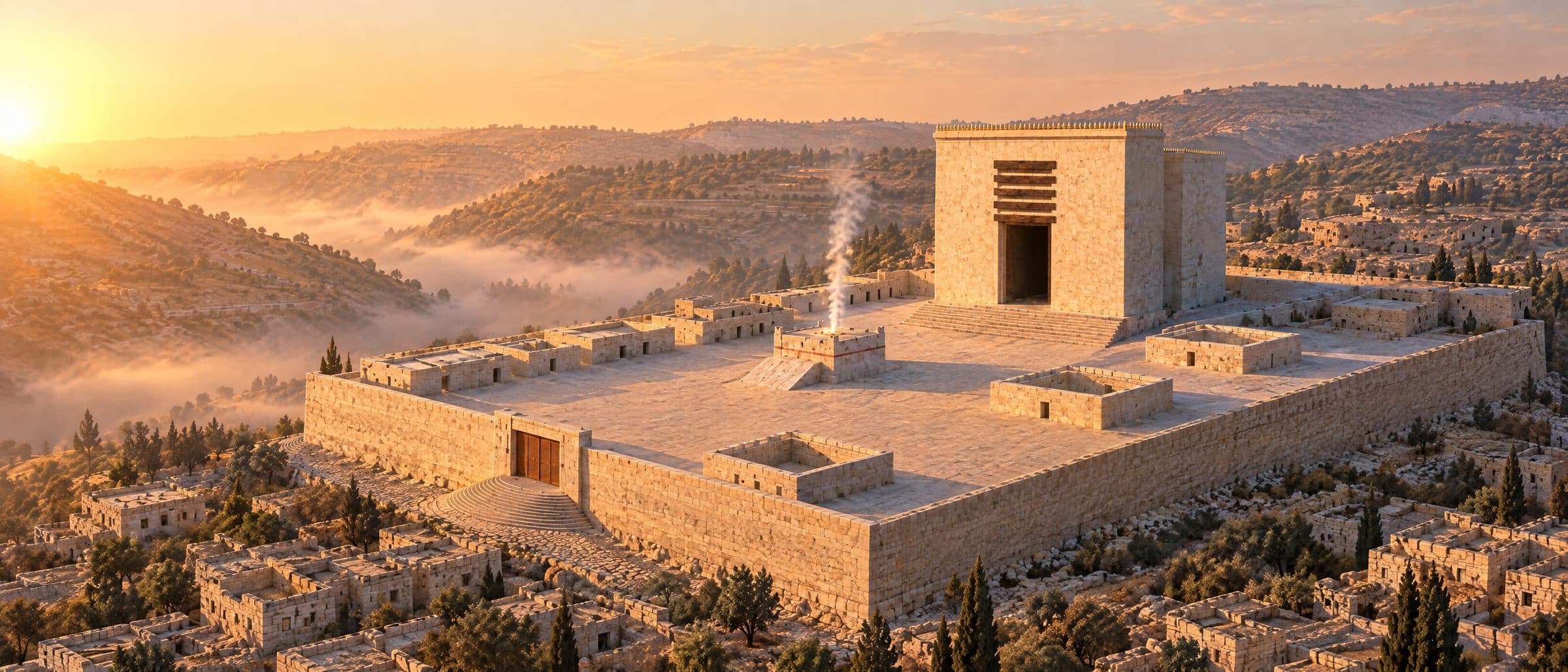
Reconstruction: sunrise over the Judean hills, the Temple platform on its ridge above a limestone city; the square-fronted Sanctuary, the low altar with a smooth ramp and a straight column of smoke.

Seven ways to describe one House

No single word covers it. A Temple, a sanctuary, the , the House. Each description below is true, and each has a source.

  • A commanded sanctuary

    Built because the Torah asks for it, to a pattern it describes.

    Torah text: Stated in the Five Books of Moses.

  • The centre of the avodah

    The place of the communal service and the offerings, morning and afternoon, every day.

    Torah text: Stated in the Five Books of Moses.

  • A house of prayer

    Solomon asks that every prayer said toward it be heard, including a foreigner's.

    Tanach prophecy: Stated in the Prophets or the Writings.

  • A destination for pilgrims

    Three times a year the whole people came up to it.

    Torah text: Stated in the Five Books of Moses.

  • A centre of Torah and national life

    The Great Sanhedrin sat in the Chamber of Hewn Stone.

    Mishnah / Talmud: Recorded in the Mishnah or Talmud, the rabbinic texts that preserve Temple practice and law.

  • The place of the Holy of Holies

    An innermost room entered by one person, on one day a year.

    Torah text: Stated in the Five Books of Moses.

  • A locus of the Shechinah

    In Jewish thought, the place where God's presence is felt most intensely among people.

    Classical interpretation: A traditional commentator's reading. Others may read the text differently.

Heaven cannot contain God

כִּי הַאֻמְנָם יֵשֵׁב אֱלֹהִים עַל־הָאָרֶץ הִנֵּה הַשָּׁמַיִם וּשְׁמֵי הַשָּׁמַיִם לֹא יְכַלְכְּלוּךָ אַף כִּי־הַבַּיִת הַזֶּה אֲשֶׁר בָּנִיתִי׃

But will God in very truth dwell on the earth? behold, heaven and the heaven of heavens cannot contain Thee; how much less this house that I have builded!
The Holy Scriptures: A New Translation

The man who built the first Temple opens his dedication by saying it cannot hold God. Judaism never taught that God lived in a building. The House is where God chose to be sought, and where people came to seek. The next verse asks that God's eyes be open toward it, night and day.

Why a physical place?

Judaism sanctifies the material world rather than escaping it. The Temple is the clearest case: not an escape from matter, but matter organised around holiness.

Time becomes
Shabbat
Food becomes
a blessing and a mitzvah
Land becomes
holy land
The body becomes
the performer of commandments
Objects becomes
sacred vessels
Architecture becomes
avodah

The why sequence

Four questions, in the order people usually ask them.

Why a Temple at all?

Torah text: Stated in the Five Books of Moses.

Because the Torah asks for one. 'Let them make Me a sanctuary' is followed by chapters of measurements, materials and procedures. Rambam counts building the House as a positive commandment that applies in every generation it can be fulfilled.

The Torah pairs the command with a reason: 'that I may dwell among them'. Among the people, not inside the building. Jewish commentators read it as a promise about a community, with a building as its focus.

Why only one?

Torah text: Stated in the Five Books of Moses.

Deuteronomy directs offerings to 'the place which the LORD your God shall choose' and forbids offering them anywhere else. Before Jerusalem, local altars were at times permitted; the Mishnah records that once the people came to Jerusalem, they were never permitted again.

Rambam states the law: after the Temple was built in Jerusalem, no other place is fit for a House of God or for offerings, for all generations. Synagogues are not temples, and nothing is offered in them.

Why Jerusalem?

Tanach prophecy: Stated in the Prophets or the Writings.

The Torah itself never names the city. It speaks of 'the place' God will choose. The identification comes later in Scripture: David buys a threshing floor and builds an altar, declares 'this is the house of the LORD God', and Chronicles places Solomon's Temple on Mount Moriah, the name of the land where Abraham bound Isaac.

That the Temple mount and the mountain of the binding are one place is a tradition built on these verses. Rambam records it as received tradition. The Psalms add the theology: 'the LORD hath chosen Zion'.

Why rebuild?

Halachah: Rambam: Codified as Jewish law by Maimonides (Rambam) in the Mishneh Torah.

Because the commandment to build did not end with the destruction, because the prophets describe a future House, and because Jewish law places rebuilding within the redemption. Rambam lists it among the acts of the messianic king.

Traditional Jewish sources do not treat rebuilding as a project for anyone to begin today at the present site. Most place it within a future that includes peace and the recognition of the nations.

The Temple is not only sacrifice

Sixteen things the House did. Select any spoke.

Divine service

The avodah: a daily order of service performed on behalf of the whole people.

Offerings are one spoke of sixteen. They matter, and the page on korbanot explains them honestly, but the House was never only an altar.

What was lost in 70 CE?

More than a building. And yet not everything.

What disappeared

  • The central service of the whole people
  • Pilgrimage in its Temple form, three times a year
  • Many of the institutions of ritual purity
  • Every commandment that depends on the Temple and its altar
  • A functioning Temple priesthood
  • A national sacred space where the people stood together

What Judaism carried forward

  • Torah
  • Prayer
  • Shabbat
  • Halachah
  • The synagogue
  • Home ritual
  • Study
  • The memory of Jerusalem
  • Hope for restoration

Rabban Yochanan ben Zakkai moved observances once kept only in the Temple into every community ‘in memory of the Temple’. Hosea had already spoken of rendering ‘the offering of our lips’.

What is known?Confidence, from primary text to unknown

Established in primary text

  • The Torah commands a sanctuary and a single place for offerings.

Classical interpretation

  • The Temple mount and Mount Moriah of the binding of Isaac are one place.

Historically supported

  • Rome destroyed the Second Temple in 70 CE.

Reconstructed

Nothing on this page at this level.

Unknown

  • When and how a future Temple will be built.